
Best Saltwater Test Kits: A Practical Guide
Saltwater Aquarium Water Chemistry: The Essential Professional Guide
Maintaining a thriving reef in Chicago starts with precision water testing. Stable saltwater aquarium water chemistry is the foundation for healthy livestock and vibrant coral growth. This guide covers the ideal ranges for pH, salinity, and nutrients. It also highlights the professional tools needed to keep your parameters in check.
The Foundations of a Healthy Reef
To help your system succeed over the long term, focus on these core chemical pillars. Our goal is to provide the local reef community with the knowledge needed to maintain stable marine environments.
Salinity and pH: These are the baselines for the health of every inhabitant in your tank. We recommend using a high-quality salt mix like Tropic Marin ProReef Salt to establish a stable mineral foundation from the start.
Nutrient Management: You should always balance Nitrates and Phosphates to prevent algae blooms while still providing energy for your corals. Tracking these levels with the Sera Nitrate NO3 Test ensures your water stays in the safe zone.
Stability over Perfection: Successful reef keepers focus on consistent parameters rather than chasing specific numbers. This approach helps new hobbyists establish healthier systems that can grow and thrive for years.
Big Fish Aquariu provides the hands-on insights needed to manage complex saltwater environments. Establishing a natural biological buffer with Arag-Alive Bahamas Oolite helps maintain the pH levels required for sensitive corals.
Whether you’re just starting your first tank or you’re an experienced reef keeper, using professional grade kits is essential. We trust tools like the Sera Calcium CA Test and the Sera Phosphate PO4 Test to ensure water chemistry remains stable and predictable.
Pro Tip: Consistency is the key to a beautiful reef. Rapid fluctuations in water chemistry are the primary cause of coral stress. Aim for ranges that your specific system can hold steady over time.
Building Success in the Chicago Reef Community
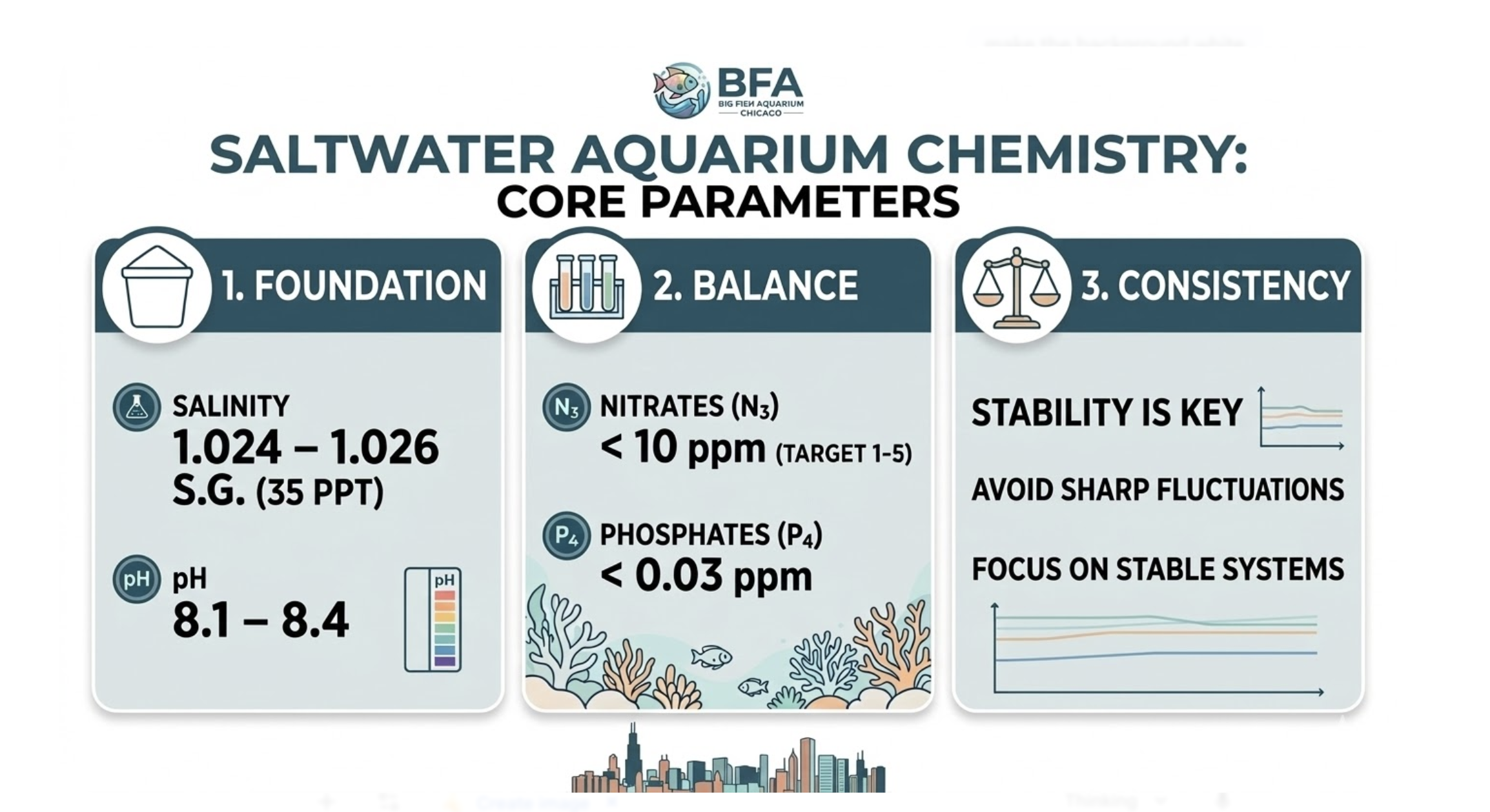
While these ranges are the gold standard for success, maintaining stability within them is more important than chasing a specific number. Rapid swings in pH or Salinity are the leading causes of livestock stress in any reef environment. We recommend a consistent routine with Tropic Marin ProReef Salt and a quality substrate like Arag-Alive Special Grade Reef Sand to help buffer your system naturally. Focus on the health of your inhabitants rather than the digits on a screen to ensure your Chicago reef thrives for years to come.
Selecting Your Testing Tools
Accuracy is the difference between a thriving reef and a struggling tank. Based on our current inventory, here is what we recommend for every level of the hobby:
-
Professional Laboratory Analysis (The Ultimate Check)
For the most detailed view of your water chemistry, we use Tropic Marin Professional ICP Seawater Analysis.
This is not just a home kit. It is a laboratory grade deep dive into your trace elements and water purity.
Best for: Solving mysterious coral stress or performing quarterly system health checks.
-
Specialized Reef Parameters
When monitoring coral specific nutrients, precision matters. We stock specialized tests for the "invisible" elements that impact growth and color.
Alkalinity and Hardness: Use sera gH-Test (General Hardness) for freshwater setups and Tropic Marin reagents for marine systems.
Nutrient Management: We carry Fritz Aquatics and Tropic Marin solutions for tracking Phosphates and Nitrates.
Best for: Enthusiasts who want to maximize coral growth and vibrant coloration through precise nutrient control.
-
Digital & Electronic Testing
For daily convenience and high speed results, we recommend moving to digital. Electronic testers eliminate the "color guessing game" found in traditional liquid kits.
Best for: High frequency testing of pH, Salinity, and TDS.
Pro Tip from the Big Fish Aquarium Team:
If you are starting a new tank or battling a chemical spike, we are here to help. We keep Turbo Start 700 Freshwater and Fritz Coppersafe in stock to stabilize your chemistry and protect your livestock during transitions. These professional grade solutions provide the immediate support needed to keep your system safe while you work toward long term stability.
The AQUARIUM Testing Schedule for Success
Using professional aquarium testing equipment or a high-precision saltwater tester helps you identify trends before they become emergencies. This schedule is designed to help the Chicago reef community maintain a thriving ecosystem.
1. New Aquarium Setup (The Cycling Phase)
Frequency: Daily.
What to test: Ammonia, Nitrite, and Nitrate.
The Goal: Monitor the Nitrogen Cycle. Do not add sensitive livestock like corals until Ammonia and Nitrites consistently read 0 ppm. We recommend using Turbo Start 700 Freshwater to accelerate this process safely.
2. Established Reef and Community Tanks
Frequency: Weekly.
What to test: Salinity, Alkalinity, and Nitrates.
The Goal: Check for "Parameter Drift." Small weekly adjustments prevent the massive swings that cause coral bleaching or fish stress. Use a digital salinity pen or Sera NO3-Test for the most consistent weekly results.
3. After System Changes
Frequency: 2 to 3 times per week for 14 days.
When to do this: Perform these tests after adding new livestock, switching to Tropic Marin ProReef Salt, or installing new hardware like a HYDROS Controller.
The Goal: Ensure your biological filtration is adapting to the new bio-load or that your new salt mix is not shifting your baseline Alkalinity.
4. Deep Dive Analysis
Frequency: Quarterly (Every 90 Days).
What to test: Full trace element profile via ICP Seawater Laboratory Analysis.
The Goal: Identify hidden deficiencies in Iodine, Strontium, or Potassium that standard home kits cannot detect. We utilize TM Professional PLUS ICP Seawater Analysis for this laboratory grade deep dive.

A thriving reef ecosystem depends on chemistry, not guesswork. Utilizing high-precision saltwater testing equipment—from specialized reef test kits to professional digital aquarium water testers like the HYDROS Dual Inline TDS—allows you to identify parameter drift before it impacts your livestock. By integrating routine analysis with laboratory-grade tools like Tropic Marin ICP Seawater Analysis, you ensure a stable, vibrant environment where both fish and corals can reach their full potential for years to come.
Expert Stability Support
Stability is the foundation of every 'Success Path,' but keeping your Alkalinity and pH$dialed in shouldn't feel like a second job. We’ve spent 25 years mastering the science behind Chicago’s water chemistry so you don't have to. If you’re ready to stop guessing and offload the technical testing to the specialists at BFA, we’re ready to step in.